Wave primacy
Physical and cognitive processes are described through amplitude, phase, frequency and coherence; discrete states are treated as emergent approximations.
THE ARCHITECTURE OF REALITY · PAPER I
An Architectural Framework for Coherence-Regulated Reality
ABSTRACT / POSITION
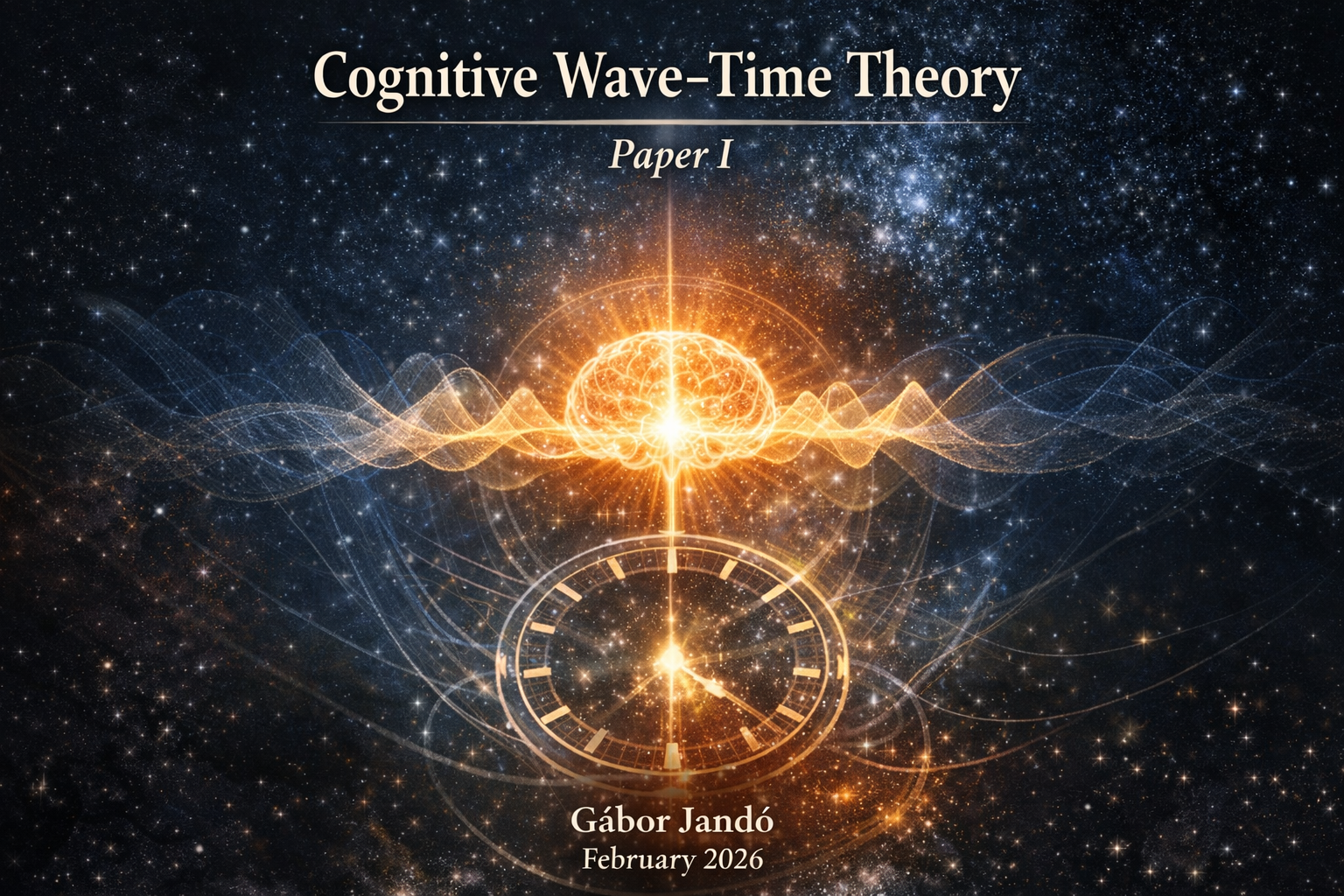
CWTT is an architectural framework in which time is not assumed as a primitive dimension. Temporal ordering, persistence and stability arise from regulated coherence across interacting wave-based systems.
The framework reinterprets observation as embedded participation, memory as phase re-accessibility, and ordering as a property of coherence-based accessibility. It offers a complementary structural perspective: it does not claim to replace existing physical theories or provide a complete dynamical theory, quantum-gravity model or model of cognition.
Time does not flow as an independent variable; it unfolds as coherence is continuously re-stabilized across interacting layers.
Time density aggregates the coherence of participating layers, weighted by attention or coupling strength.
A boundary condition and coherence anchor that selects which wave layers participate in accessible experience.
CONCEPT FILM · 01
A short visual introduction to layered wave dynamics, coherence-regulated accessibility and temporal unfolding.
Download vertical edition ↓CONCEPT FILM · 02
Illustrative temporal layers unfold at distinct characteristic frequencies, then overwrite and modulate one another within a shared field of coherent access.
FOUNDATIONAL STRUCTURE
The formal core connects wave dynamics, prediction, participation, relational ordering and bounded feedback.
Physical and cognitive processes are described through amplitude, phase, frequency and coherence; discrete states are treated as emergent approximations.
Internal predictive patterns and environmental input meet as phase relations. Stability requires bounded mismatch rather than perfect forecast.
Observation is an embedded, bidirectional interaction that forms a closed coherence loop rather than an external observer-object split.
Ordering is derived from relational coherence between interacting layers, not from an intrinsic universal clock.
A bounded participation operator adjusts phase relations without a reference trajectory, predefined time axis or optimization objective.
CONCEPTUAL PLATE
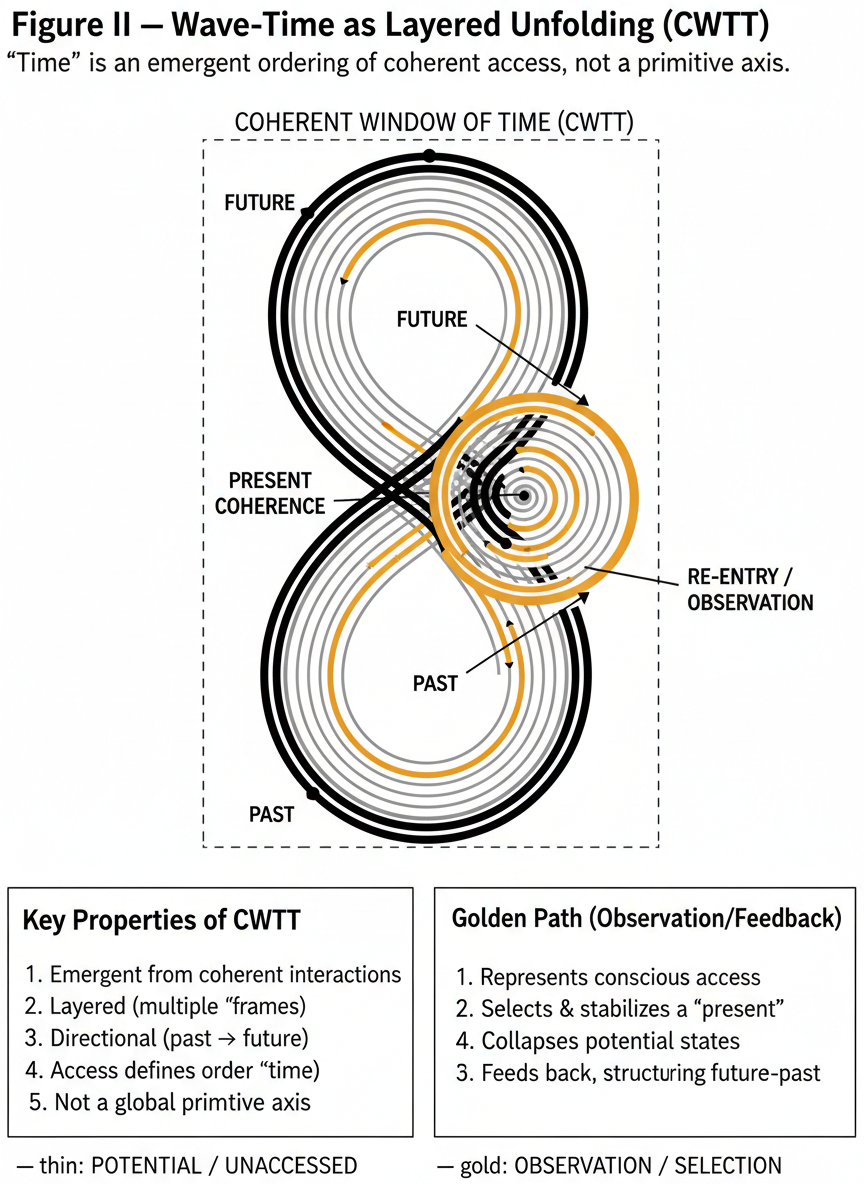
The diagram depicts a coherent window in which past, present coherence and future are organized through layered access. The golden path represents observation and feedback: selection stabilizes a present configuration and structures subsequent re-entry.
This is a conceptual architecture, not a literal spacetime geometry. Its role is to show how ordering can be expressed through coherence and accessibility without treating time as a global primitive axis.
ARCHITECTURAL CONSEQUENCES
Embedded participation and bandwidth-limited coupling determine which states become accessible.
Memory is phase re-accessibility: the capacity to re-enter previously coherent basins under appropriate conditions.
Persistence rests on loop stability and characteristic re-entry, rather than exact repetition or uninterrupted temporal continuity.
Causal order is reframed as reachability through coherence-preserving transformations.
SCOPE & BOUNDARIES
CWTT addresses systems exhibiting sustained coherence, regulation-based stability, re-accessible memory and emergent temporal ordering.
PUBLICATION RECORD
Jandó, G. (2026). Cognitive Wave-Time Theory: An Architectural Framework for Coherence-Regulated Reality [Preprint]. Zenodo.
Paper I establishes the architectural ground. Paper II turns coherence regulation itself into the primary object of study.
Open the complete preprint on Zenodo ↗