Persistence
Jointly stabilised field accessibility and informational constraint across resolution layers.
THE ARCHITECTURE OF REALITY · PAPER III
Matter as Stabilised Fractal Information under Coherence Regulation
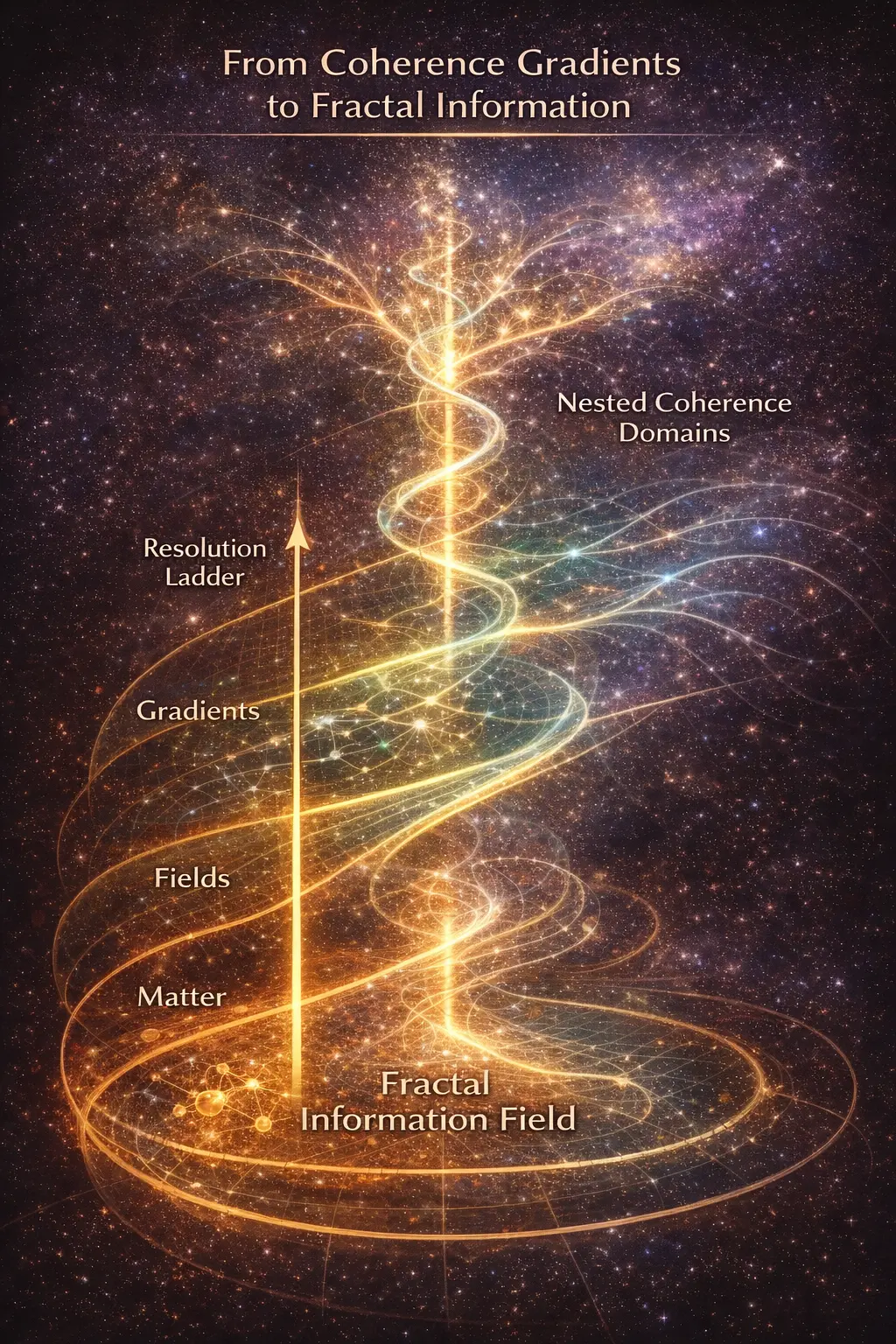
ABSTRACT / POSITION
Matter–Field–Information develops an architectural reinterpretation of matter, fields, information, thermodynamics and objectivity through coherence, accessibility, resolution and bounded regulation.
Its central proposal is that matter may be interpreted as stabilised fractal information: a regime in which scale-consistent informational structure remains repeatedly accessible under coherence regulation. Established physical formalisms are preserved within their operational domains; the paper proposes a relational scaffold beneath them.
Jointly stabilised field accessibility and informational constraint across resolution layers.
A structured domain of coherence accessibility rather than a passive background.
The organization that shapes which configurations can remain viable and re-accessible.
BRIDGE FROM PAPER II
Paper II established bounded coherence regulation within non-zero slip bands. Paper III asks what can persist when the same regulation must operate across fields, thermodynamic regimes and resolution layers.
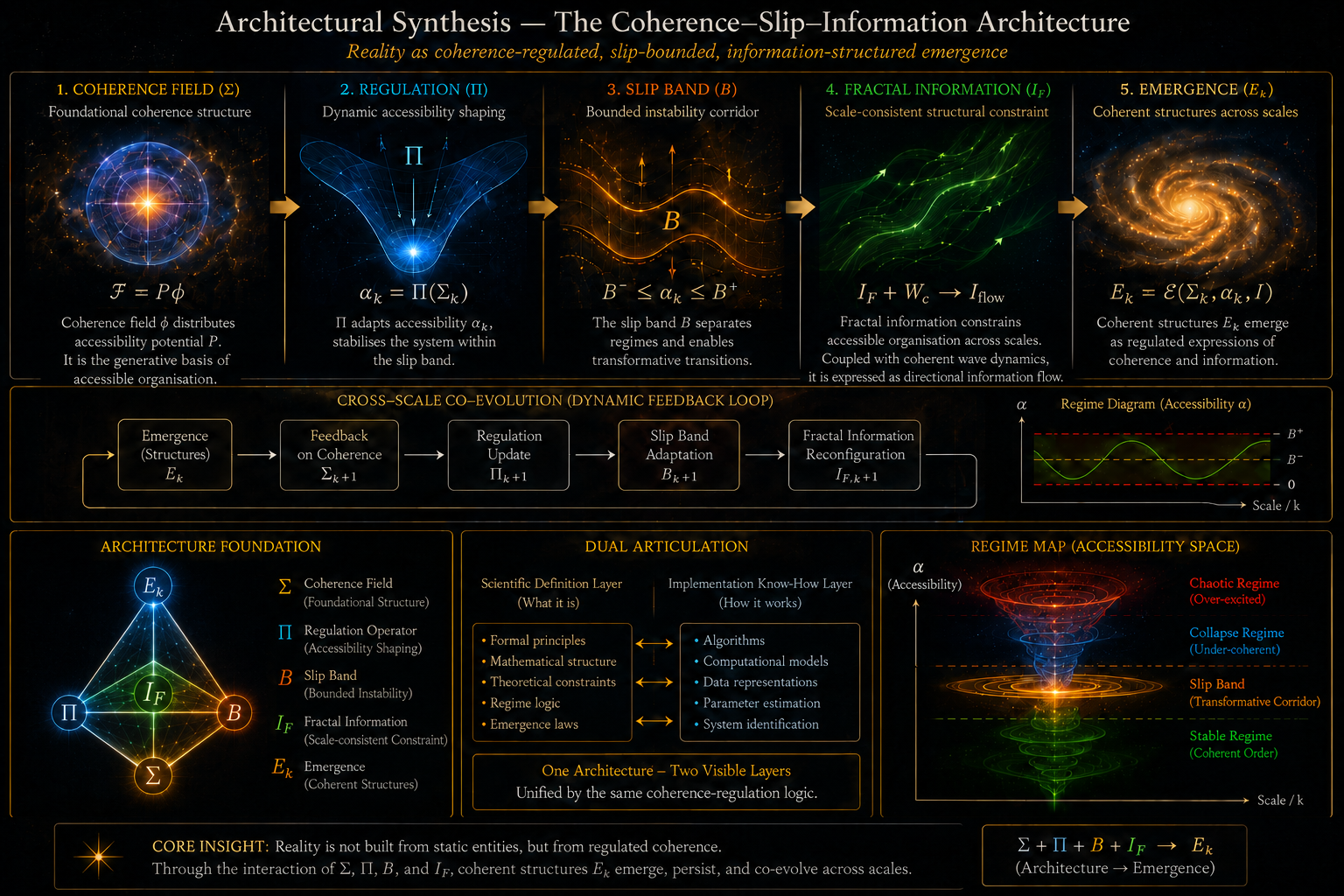
ARCHITECTURAL SYNTHESIS
The architecture unfolds from foundational coherence through regulation and bounded slip to fractal information as a scale-consistent structural constraint. Directional information flow appears when that constraint couples to coherent wave dynamics, enabling emergent coherent structures.
CONCEPT FILM · 03
A concise visual passage through the five interacting elements of MFI: coherence field, regulation, bounded slip, fractal information and emergent structure. Information flow appears as the dynamic expression of coherent-wave coupling to the fractal constraint.
Download film ↓CONCEPT FILM · 05
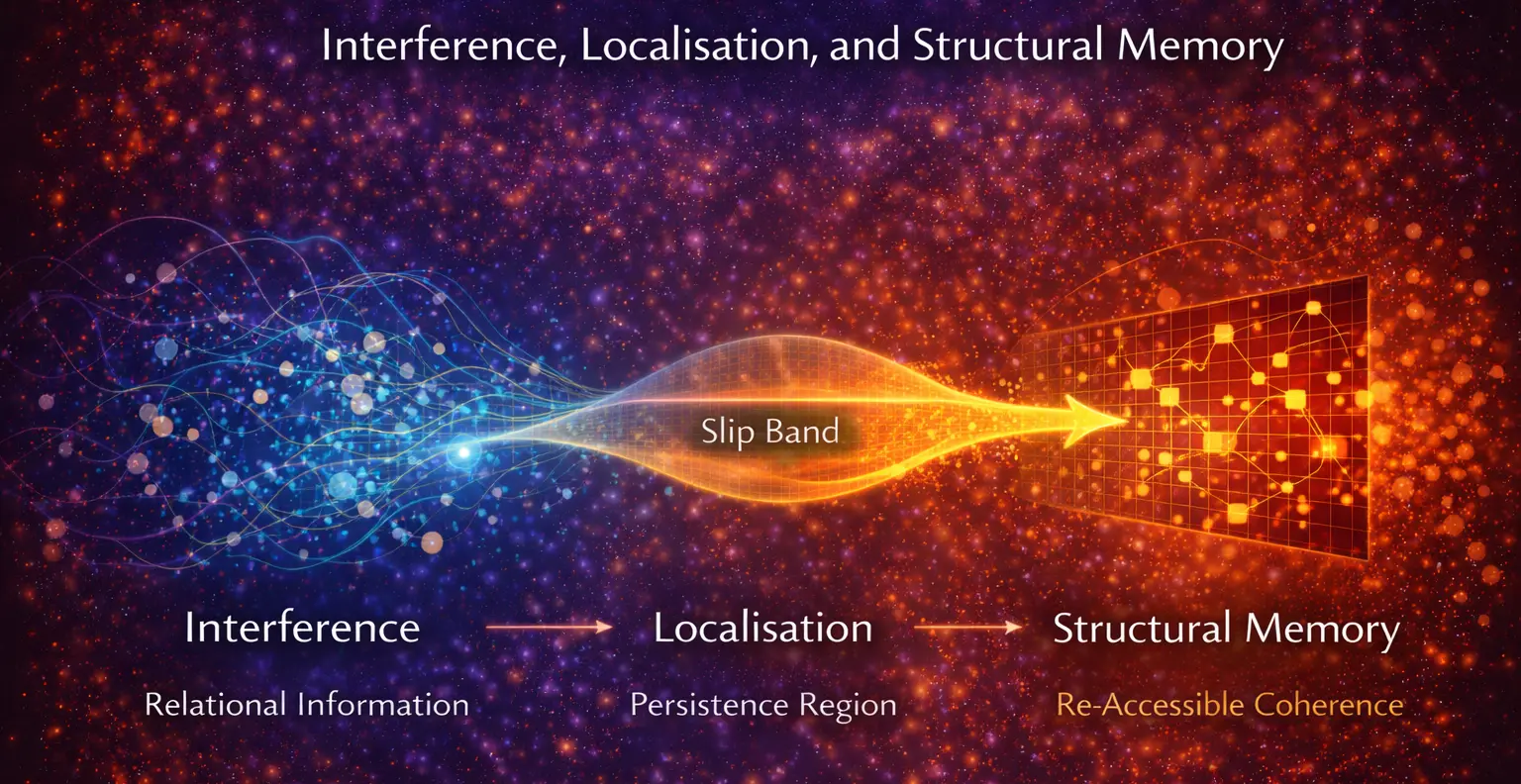
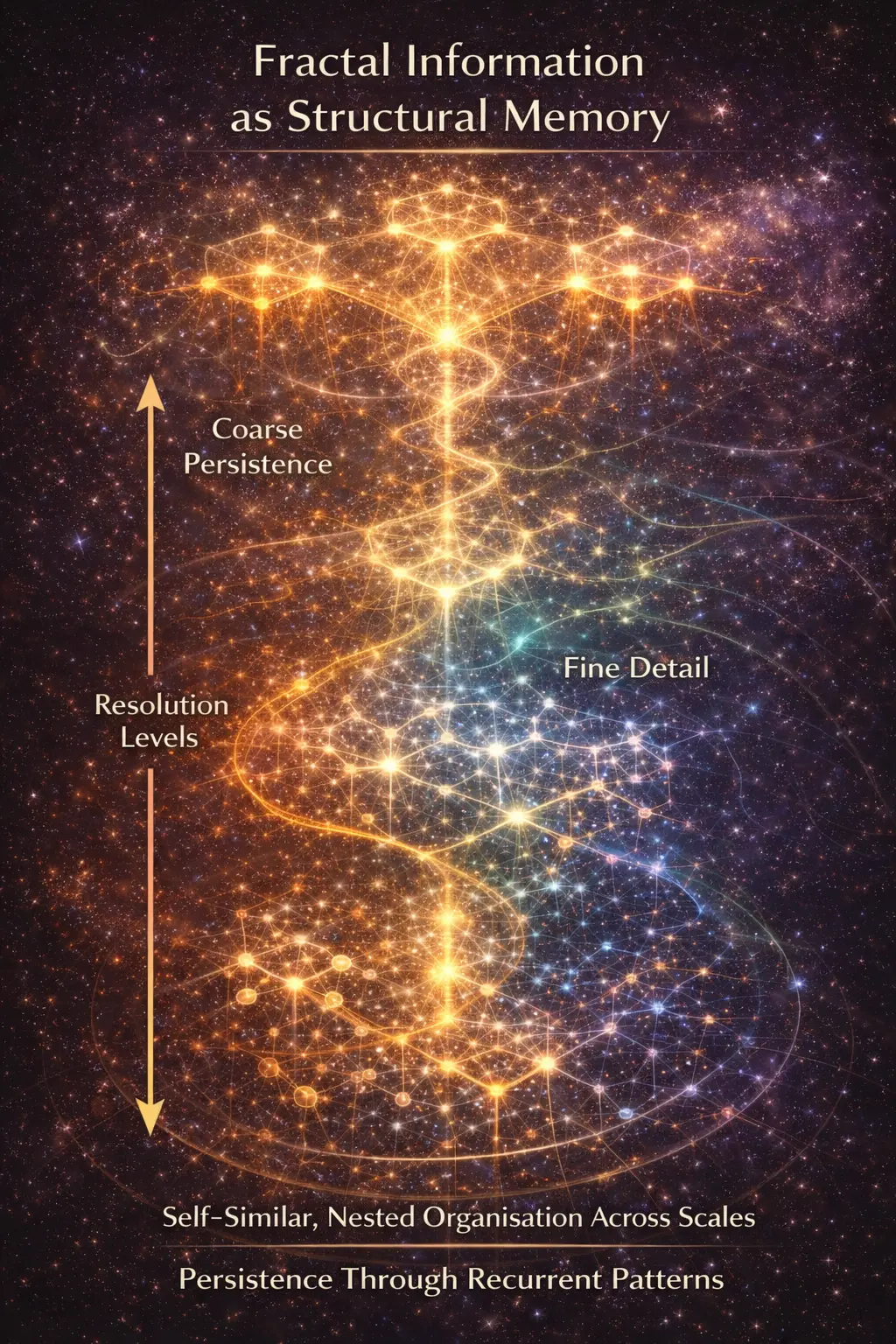
Coherent interference creates relational structure; regulated localisation allows selected configurations to persist. Structural memory is presented not as a primitively stored representation, but as organised constraint that remains repeatedly accessible.
Download film ↓COHERENCE & ACCESSIBILITY
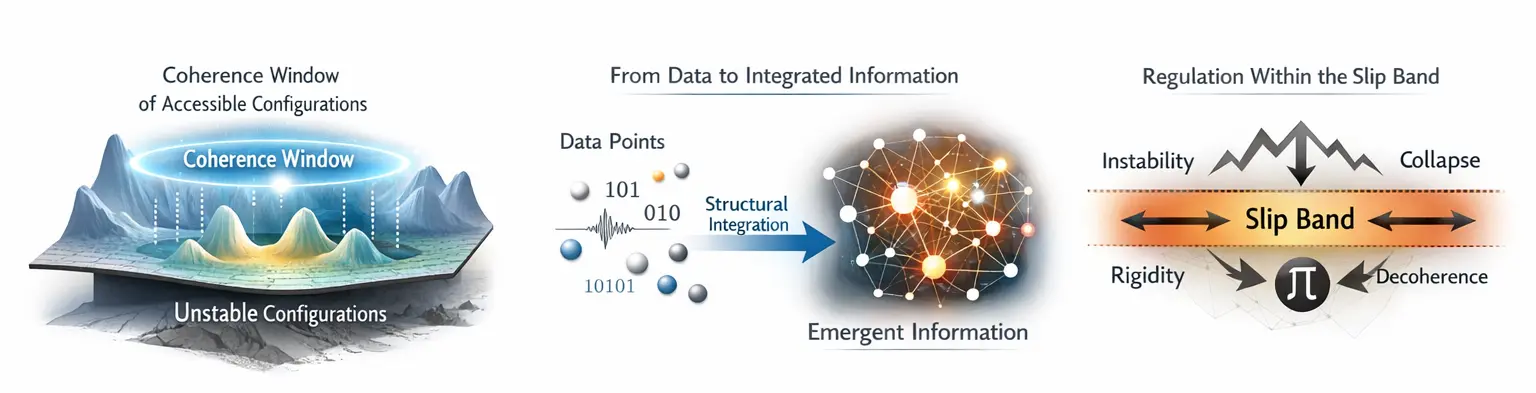
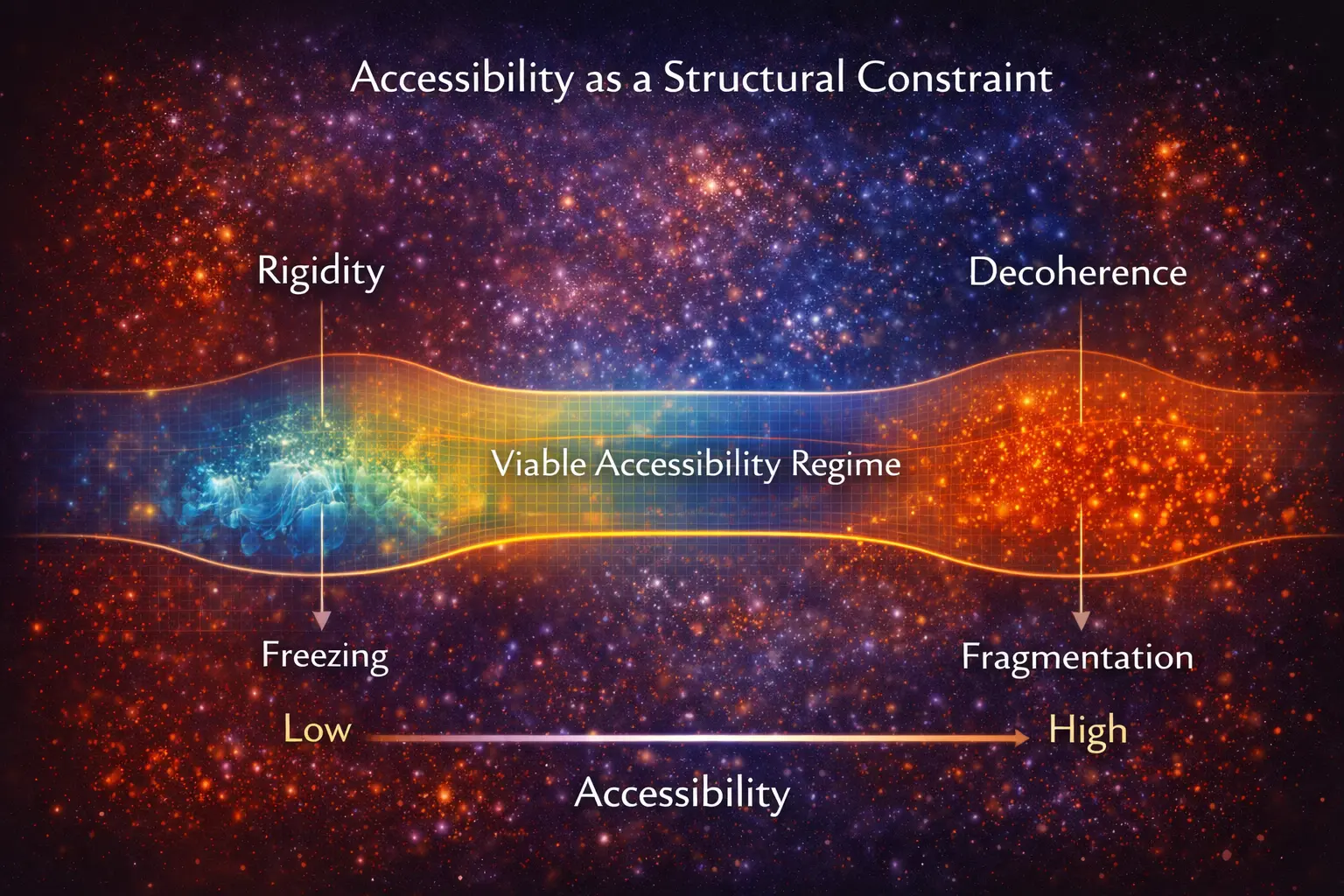
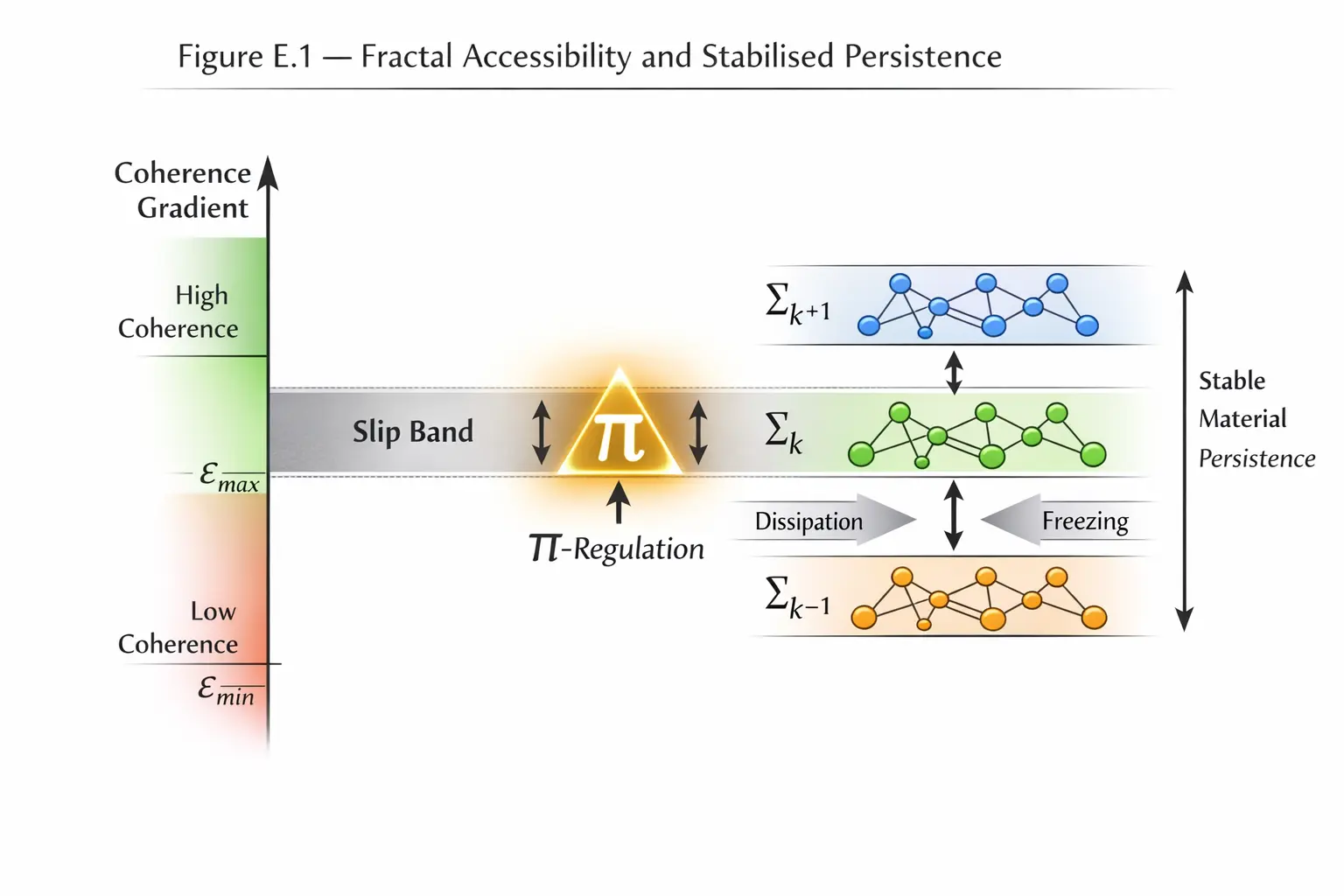
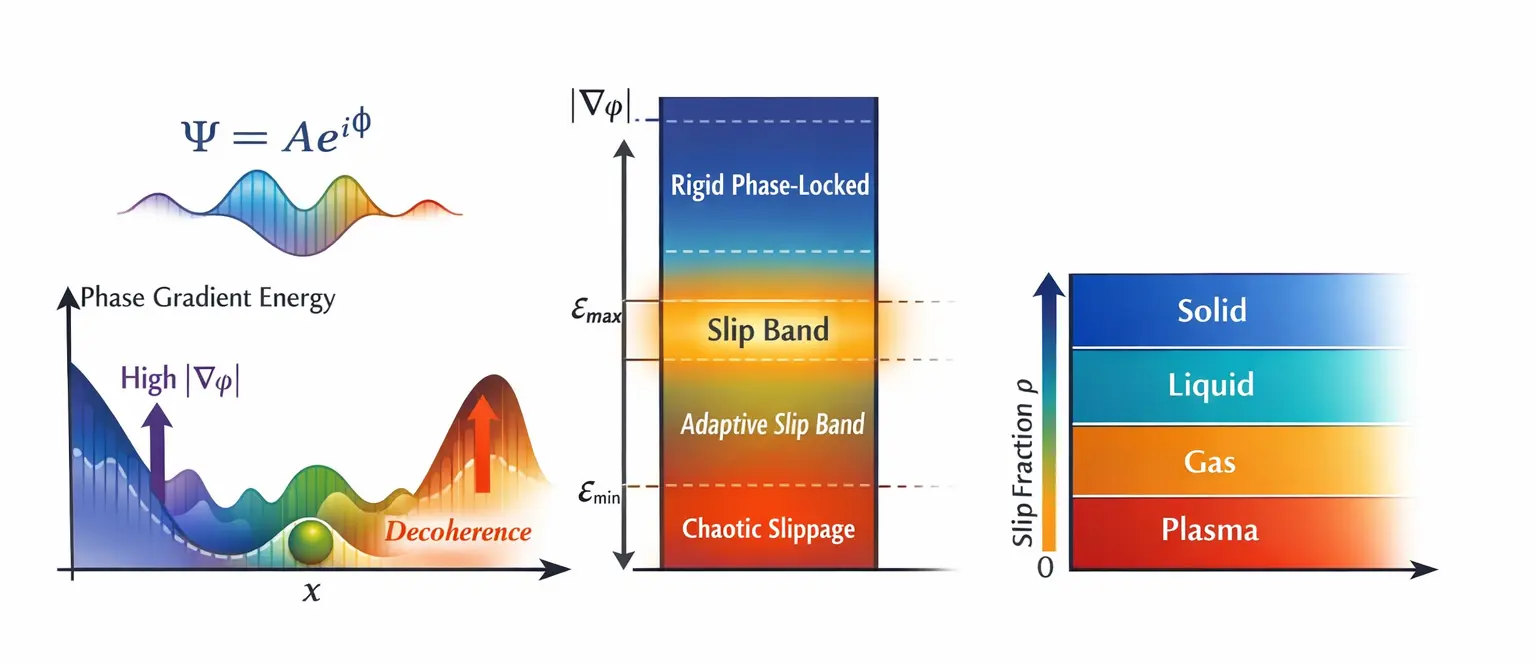
Accessibility acts as a structural constraint. Excessive locking tends toward rigidity, while excessive dispersion tends toward decoherence and fragmentation. A viable regime lies between these limiting tendencies and remains dynamically regulated.
Slip bands operate as interfaces between local structure and global coherence, allowing bounded difference to be absorbed and reorganised across scales.
STABILISED PERSISTENCE
The Π operator regulates transitions among neighbouring coherence states. Material persistence is therefore framed as repeated band-preservation—not immobility or convergence to a perfectly static configuration.
INFORMATIONAL ARCHITECTURE
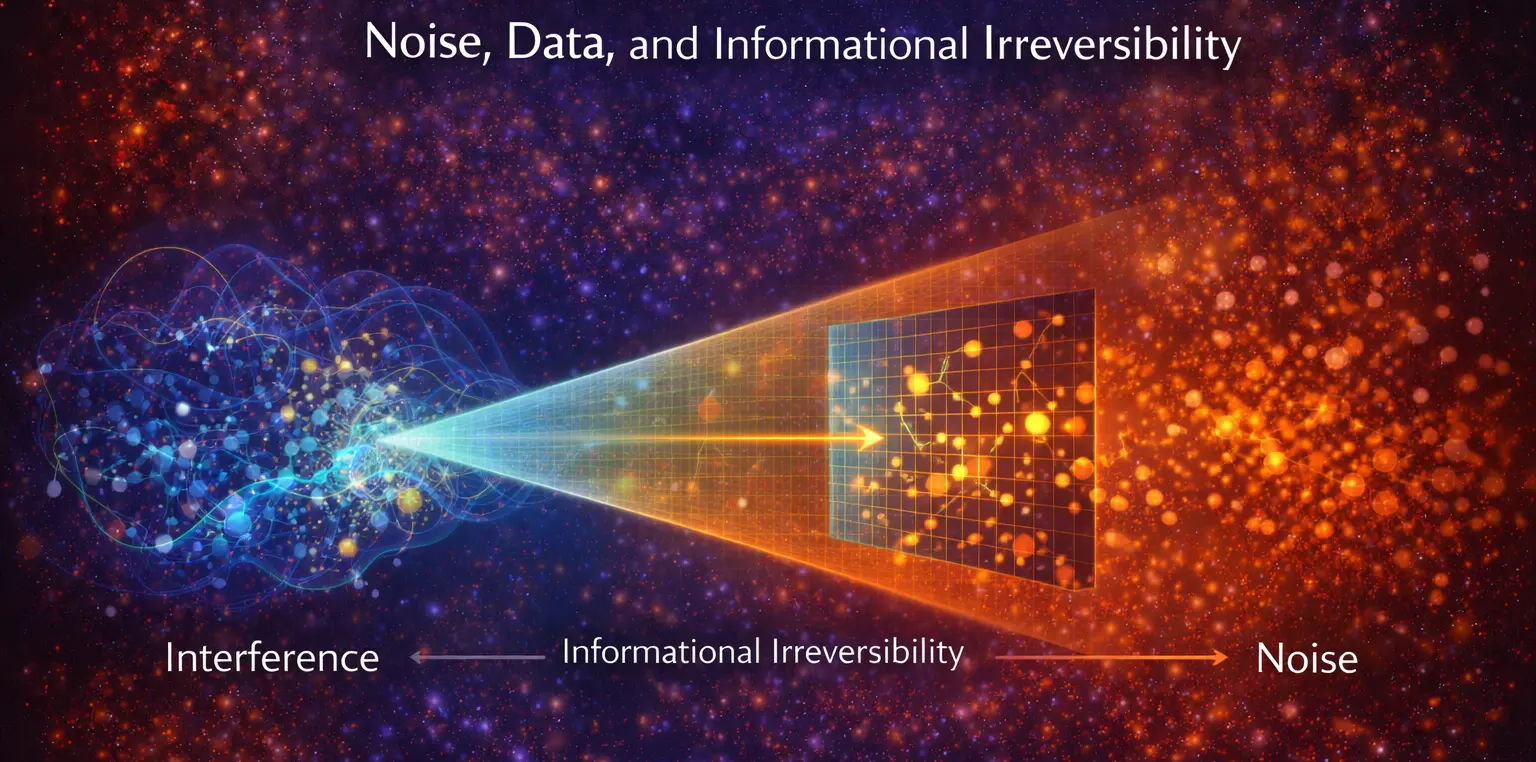
Information becomes physical in the framework when it constrains what can remain accessible and repeatable.
FIELDS & DIFFERENTIATION
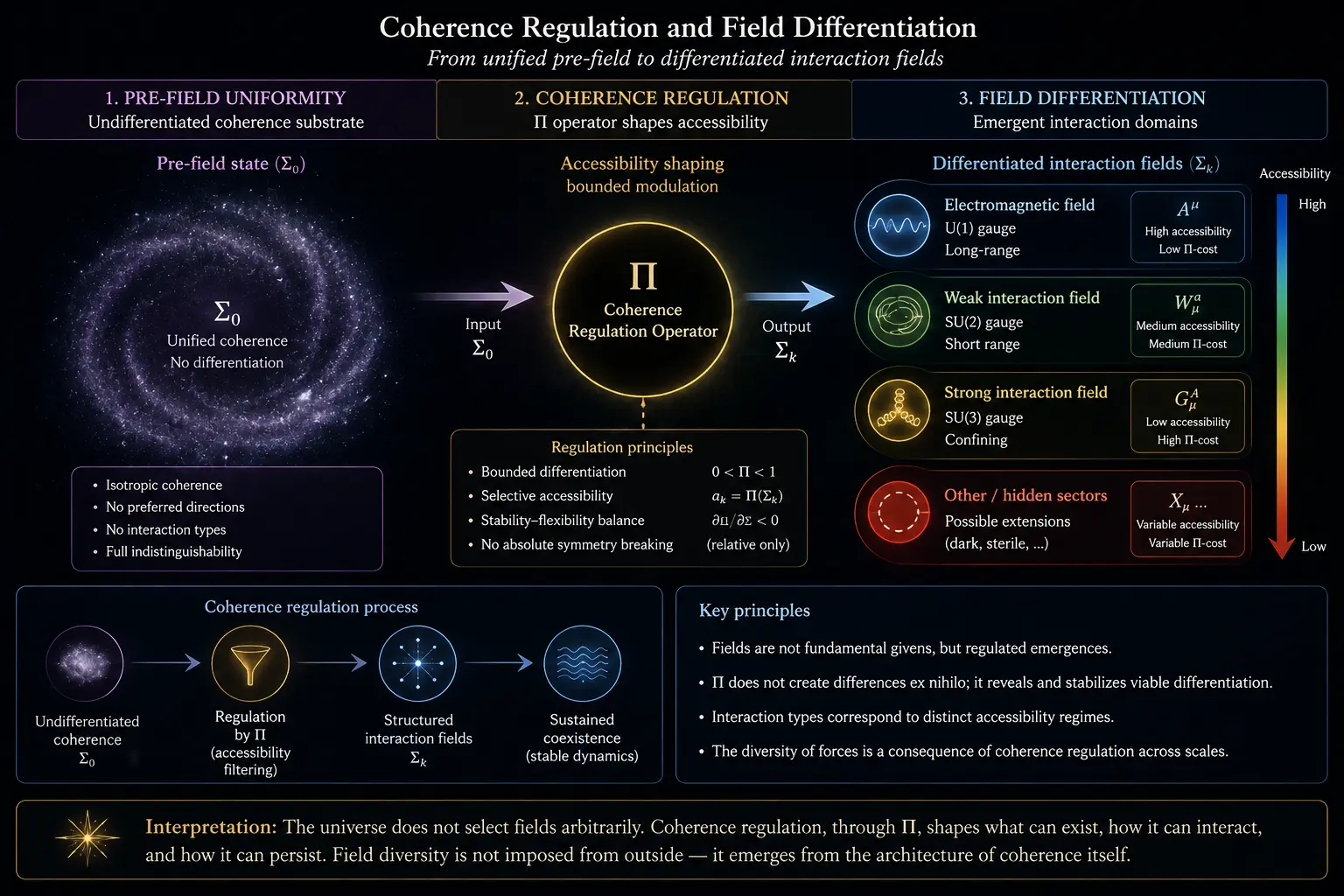
The paper treats interaction fields as differentiated regimes of coherence accessibility. The Π operator is used architecturally to describe bounded selection and stabilisation, not as a completed derivation of known gauge fields.
Physics-facing correspondences—including gauge structure, confinement, particle-like excitations and hidden sectors—are retained as programmatic extensions requiring specialised models and empirical development.
FRACTAL INFORMATION
The bridge hypothesis proposes that regulation under multi-scale drift tends to preserve information in scale-consistent form.
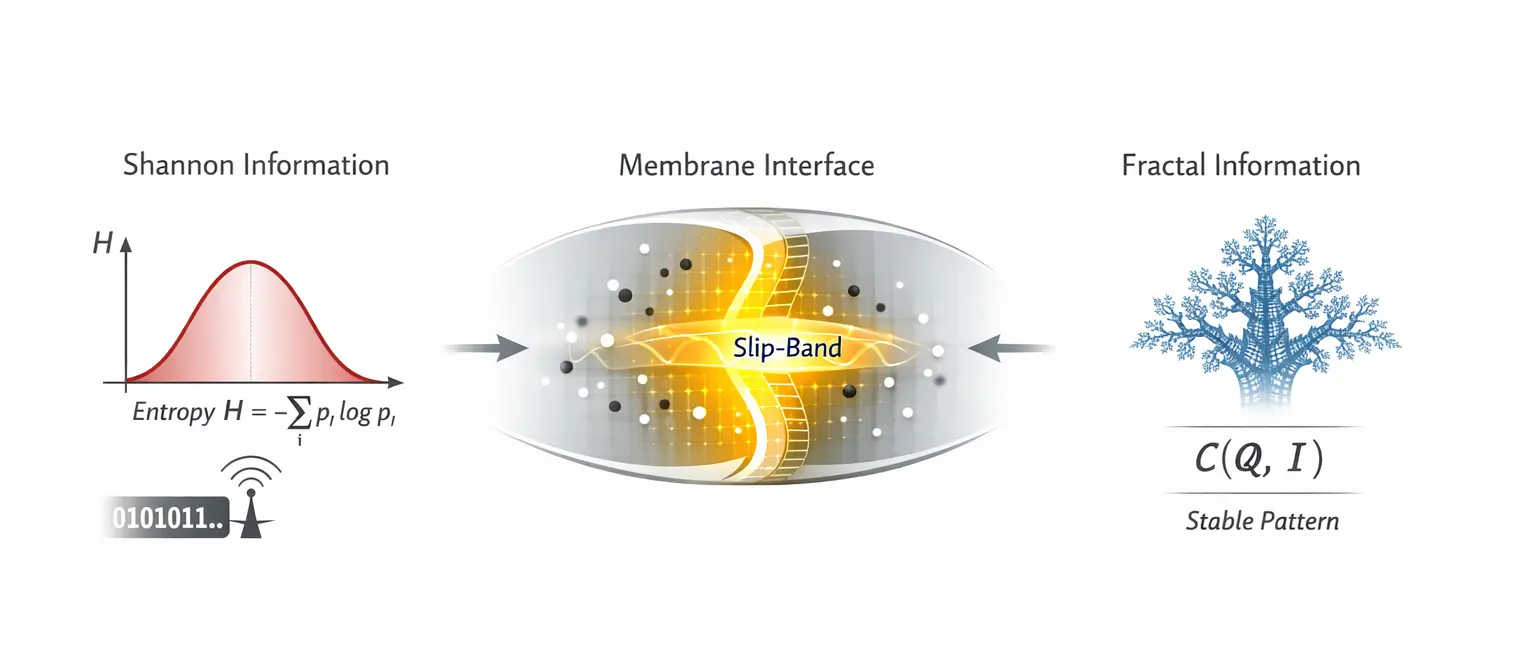
A system maintaining stability through coherence regulation under multi-scale drift will tend to preserve information in scale-consistent form.
This is presented as a bridge principle and research direction, not as a completed physical law. It motivates scaling tests, coarse-graining analyses and attention to defects, junctions, interfaces and boundary regions.
MATERIAL REGIMES
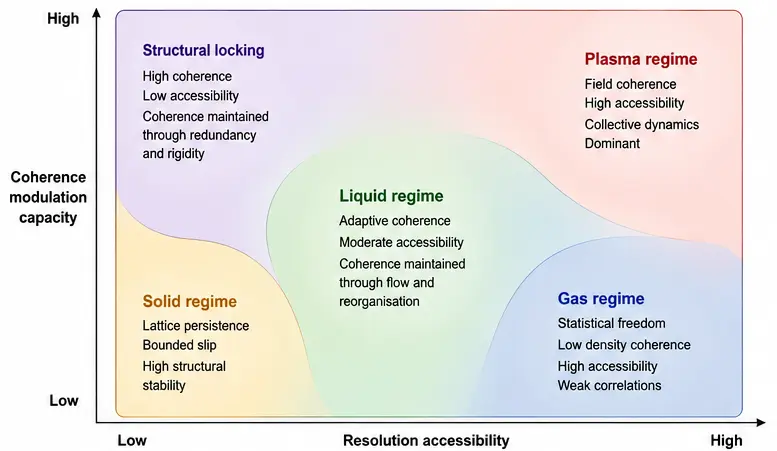
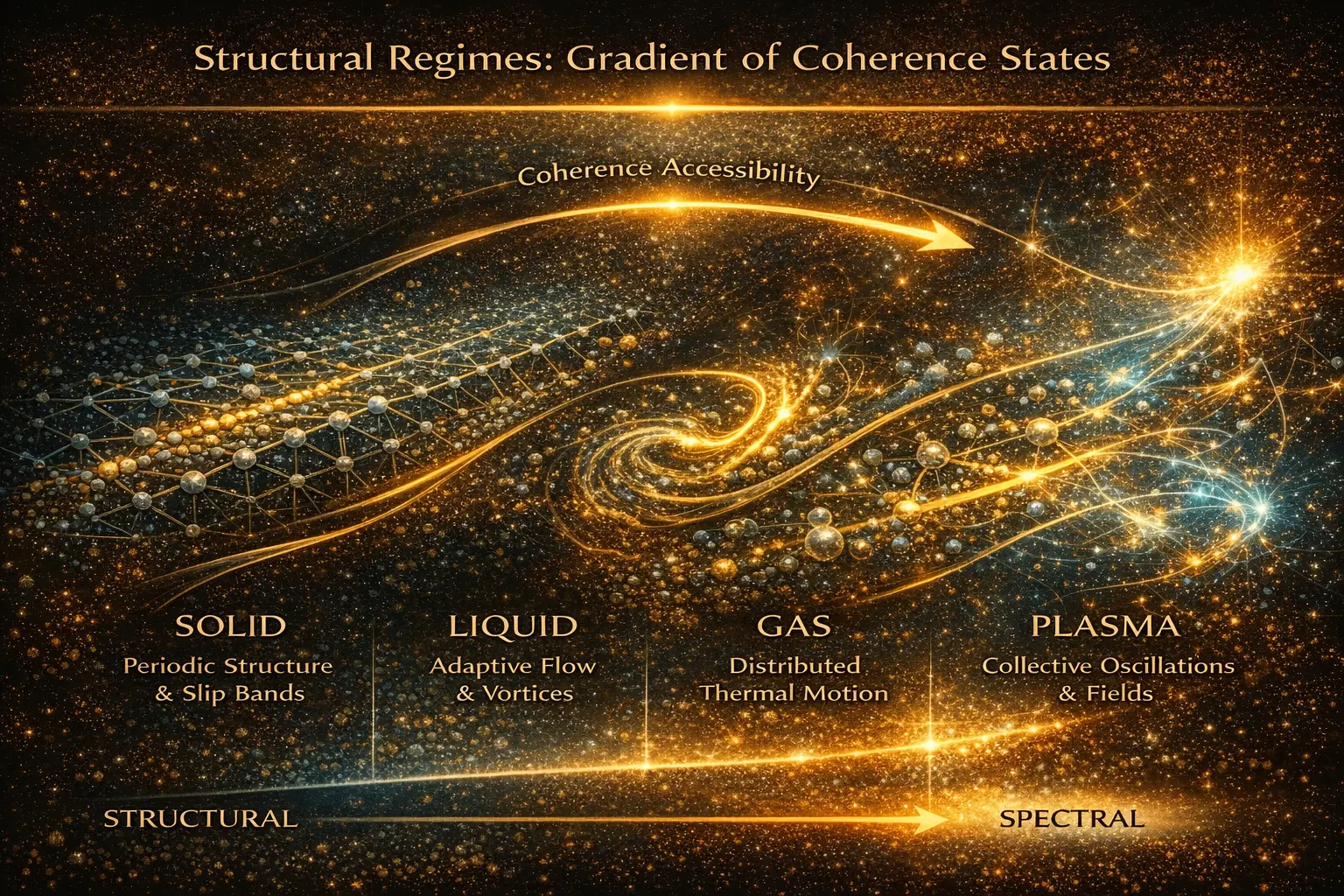
Solid, liquid, gas and plasma are read as different organizations of persistence, flow, statistical freedom and field-dominated coupling. Phase transitions correspond to crossings between viable regimes in coherence–resolution space.
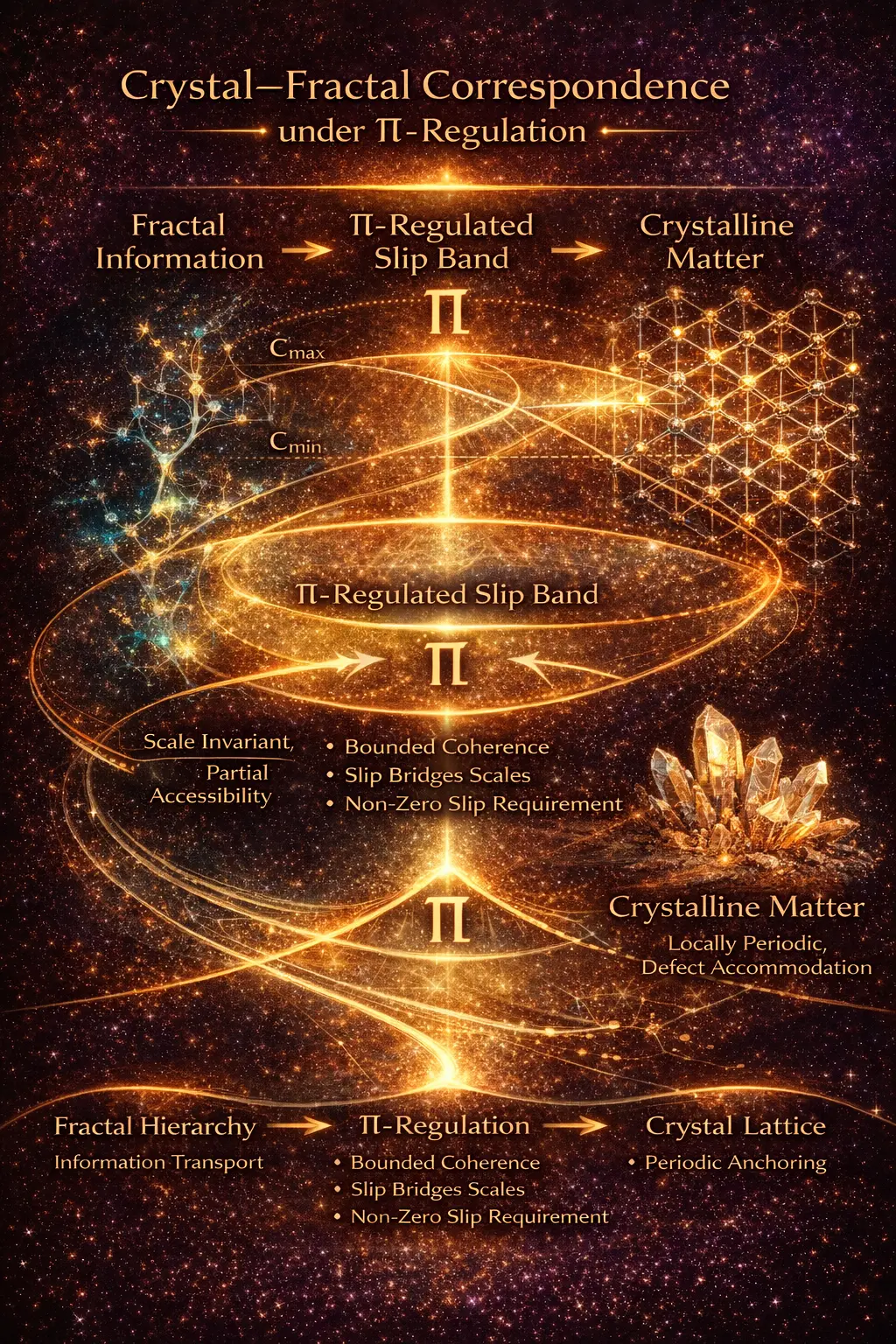
CRYSTAL–FRACTAL CORRESPONDENCE
The crystal correspondence explores how scale-distributed informational structure may close into a locally periodic material regime. Defects are not treated only as failures of order: within bounded slip, they can accommodate mismatch and support transport across scales.
This correspondence is architectural and exploratory. It proposes a research bridge between fractal accessibility, regulated defects and crystalline persistence rather than a derivation of crystallography.
FRACTAL THERMODYNAMICS
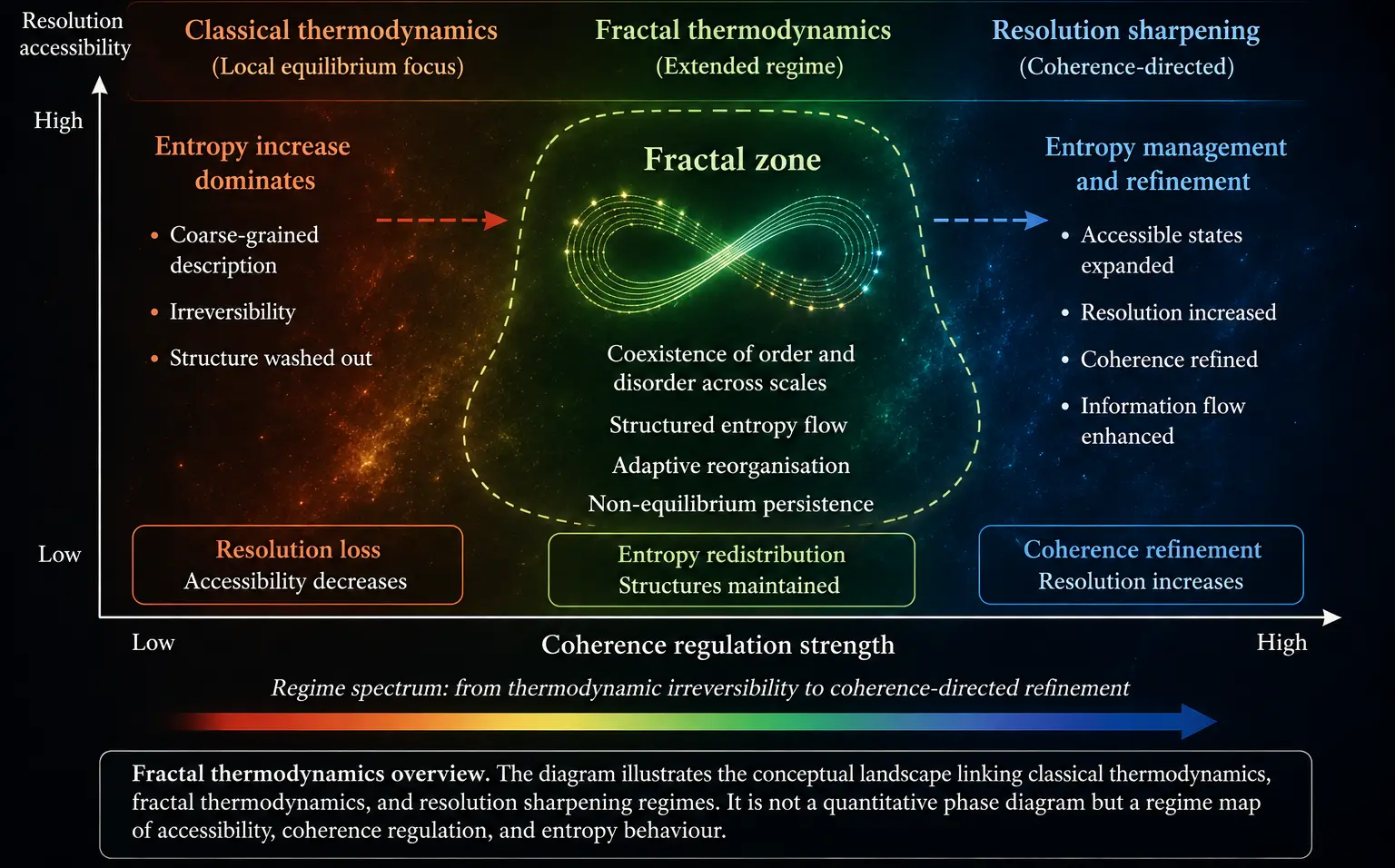
Entropy is interpreted as the effective volume of coherence-compatible configurations accessible at a given resolution. Thermodynamic irreversibility then corresponds to a loss of fine-grained accessible structure.
The second law is retained as an empirical and statistical principle. The paper interprets it as the dominant limiting regime when resolution loss exceeds the system’s capacity for coherence regulation and refinement.
THE SECOND LAW
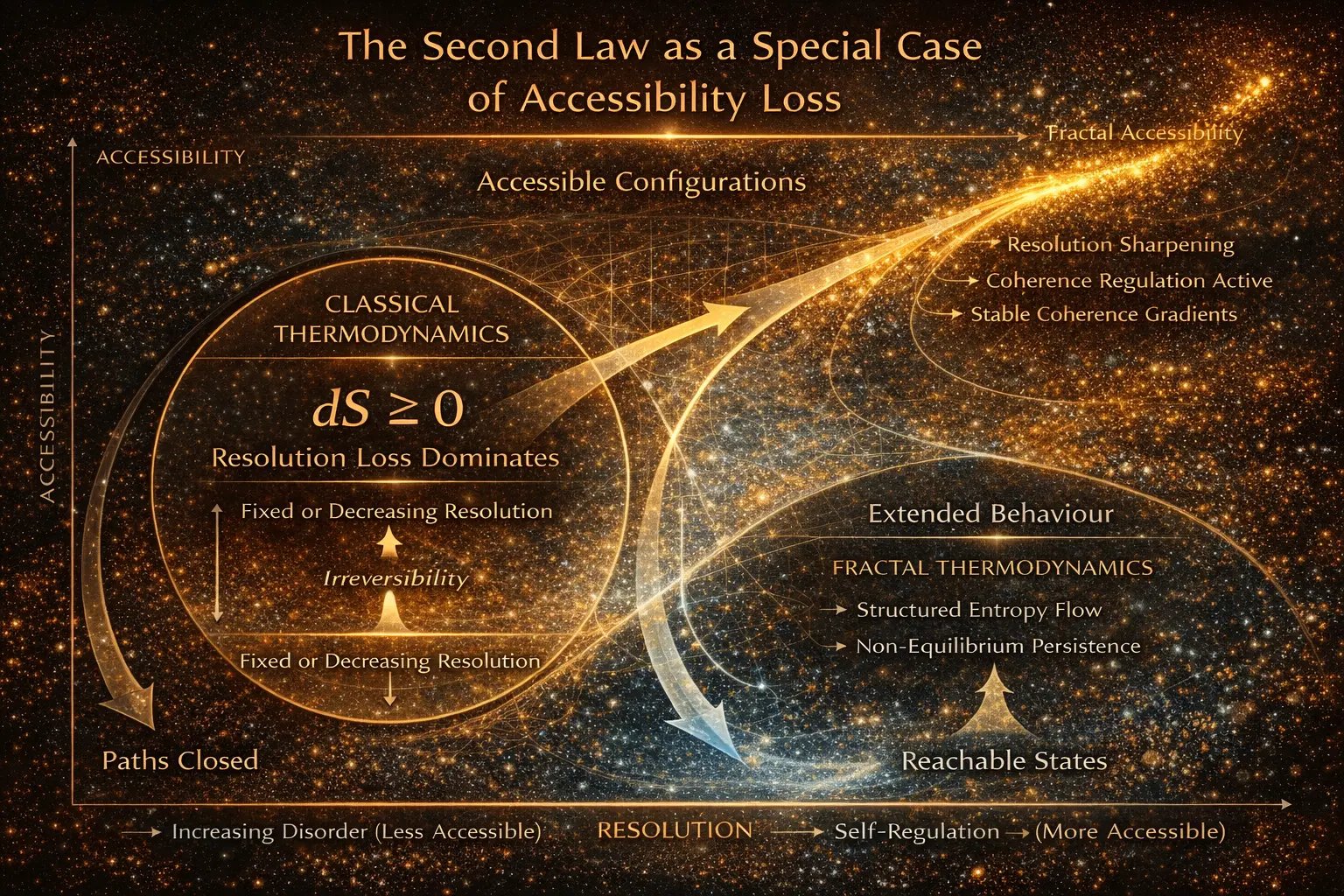
The extended interpretation does not reverse or suspend the second law. It embeds classical thermodynamic behaviour in the regime where fixed or decreasing resolution closes accessible paths faster than regulation can preserve or refine them.
CONCEPT FILM · 06
The standard thermodynamic arrow is retained. The film presents the MFI interpretation of irreversibility as the regime in which fine relational access paths close faster than regulation can preserve or refine them, leaving progressively coarser effective access.
Download film ↓SHARED COHERENCE
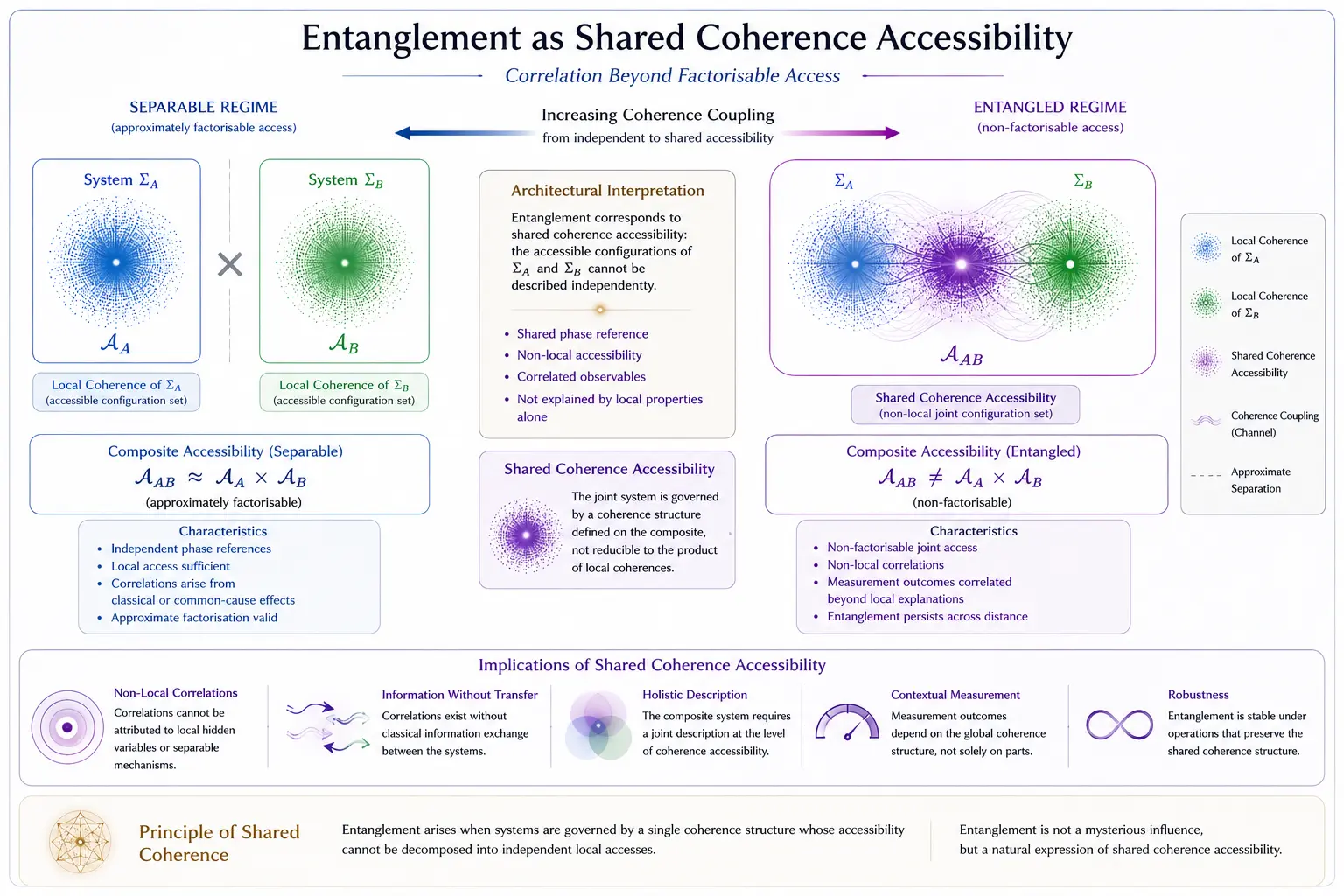
The paper offers an architectural reading of entanglement: the composite system is governed by a shared coherence structure whose accessible configurations cannot be reduced to a product of independent local accesses.
This interpretation preserves quantum formalism and its empirical predictions. It supplies a relational vocabulary for the joint structure; it does not introduce a signalling channel, local hidden variables or a replacement measurement theory.
CO-EVOLUTION
When two coherence windows share a slip band, each alters the accessibility conditions of the other. Stable coexistence is consequently expressed as continuous, reciprocal adjustment under bounded deviation.
Co-evolution extends regulation from a single persistent structure to coupled systems. It also prepares the transition from material persistence toward chemical, biological and relational organization.
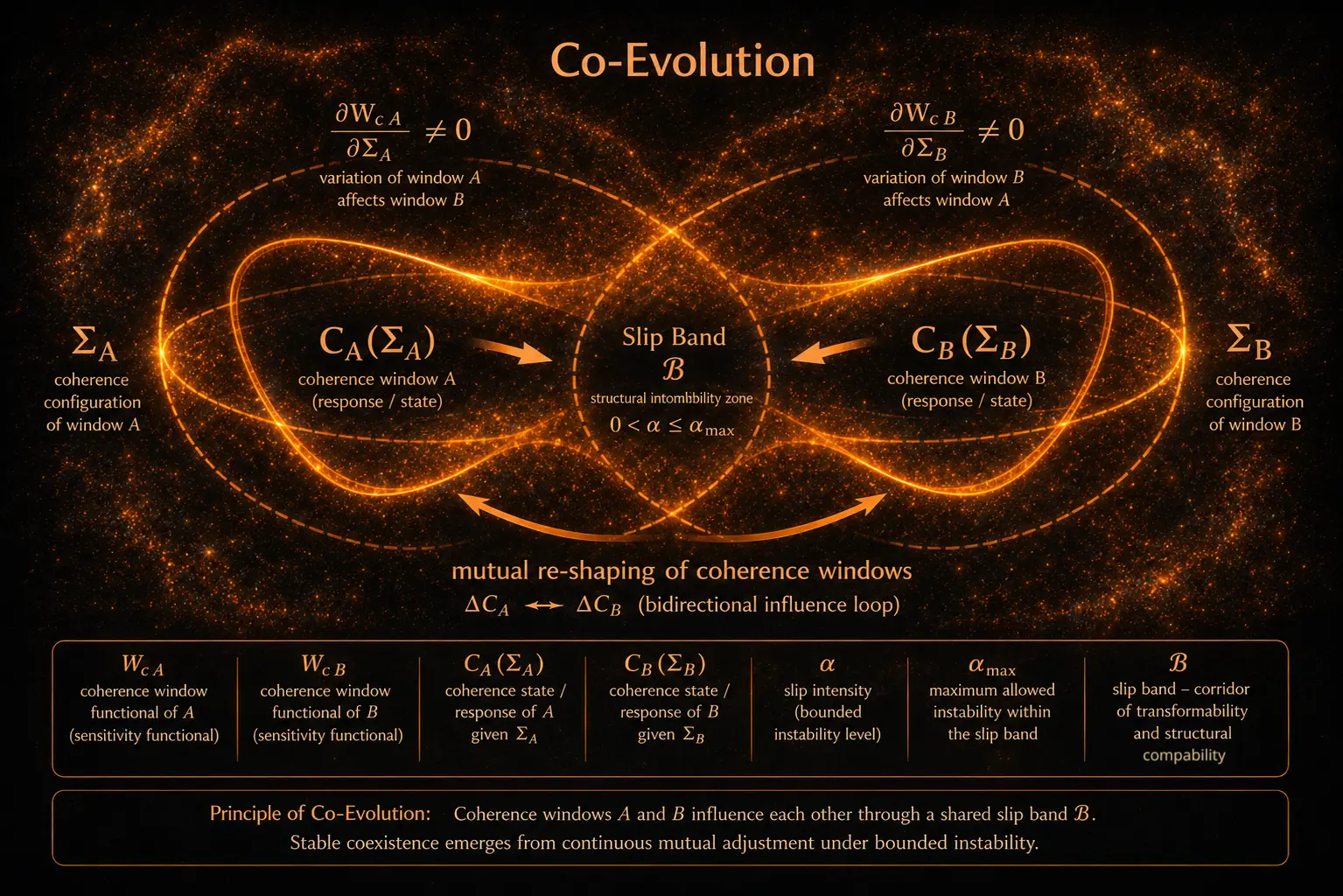
CONCEPT FILM · 07
Two initially distinct coherence windows develop a shared slip band. Their interaction changes not only their states, but the accessibility conditions under which each can remain coherent—turning persistence into a reciprocal regulatory process.
Download film ↓PROGRAMMATIC FORMAL CLOSURE
The proposed functional gathers gradient cost, fractal membrane structure and Π-regulated deviation into one modelling architecture. It is a compact research programme—not a completed field theory or a substitute for established Lagrangian formalisms.
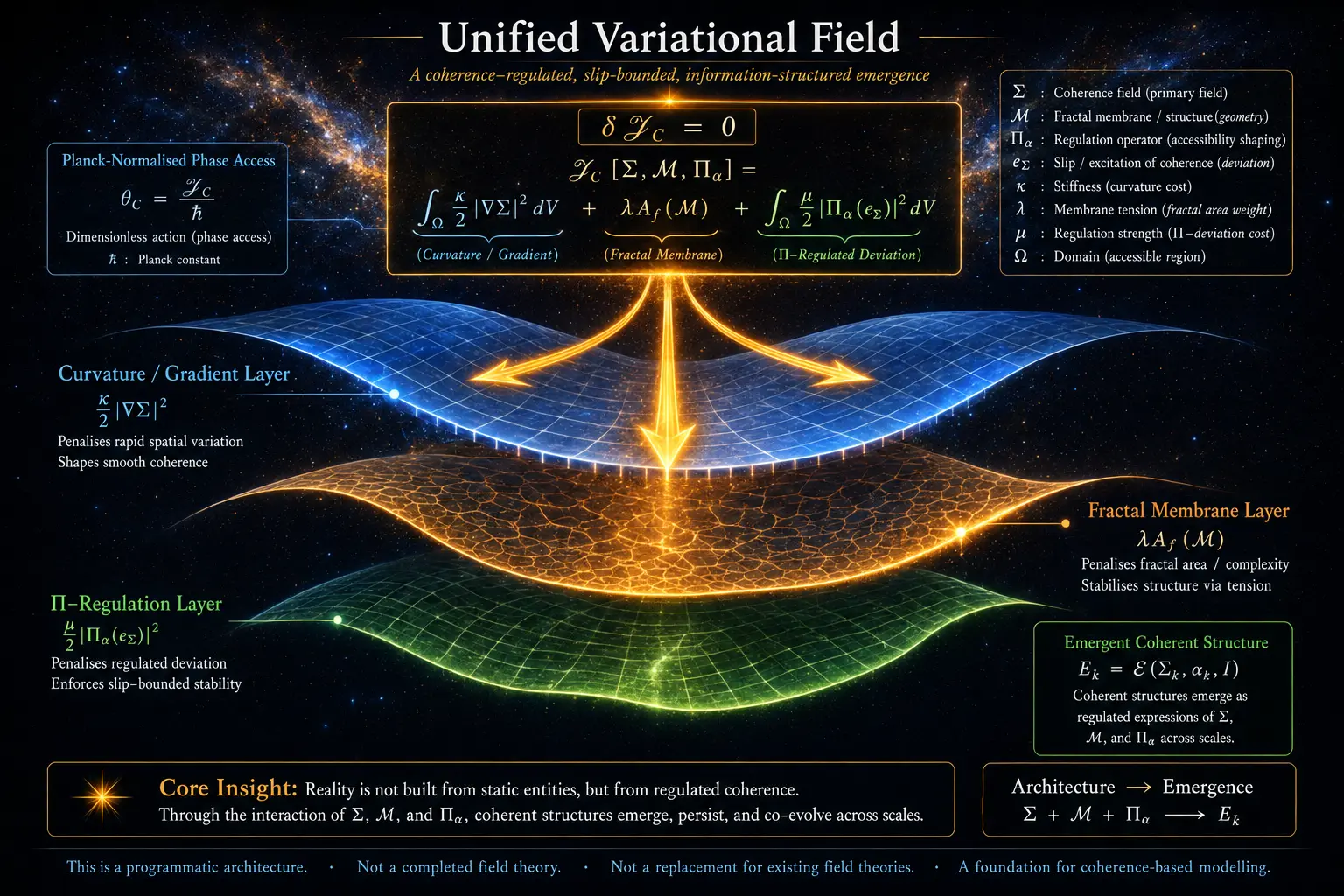
FORMAL EXTENSIONS
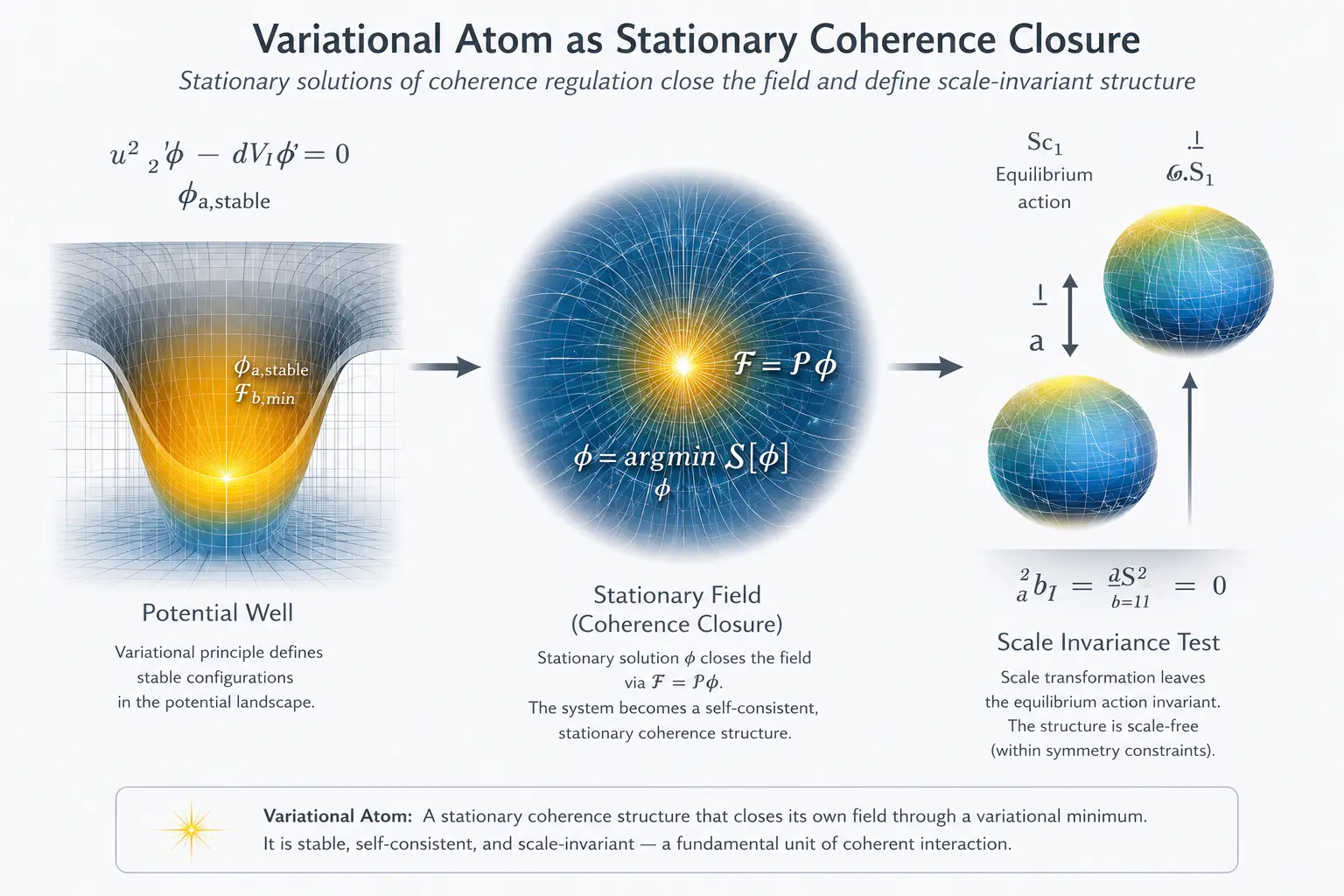
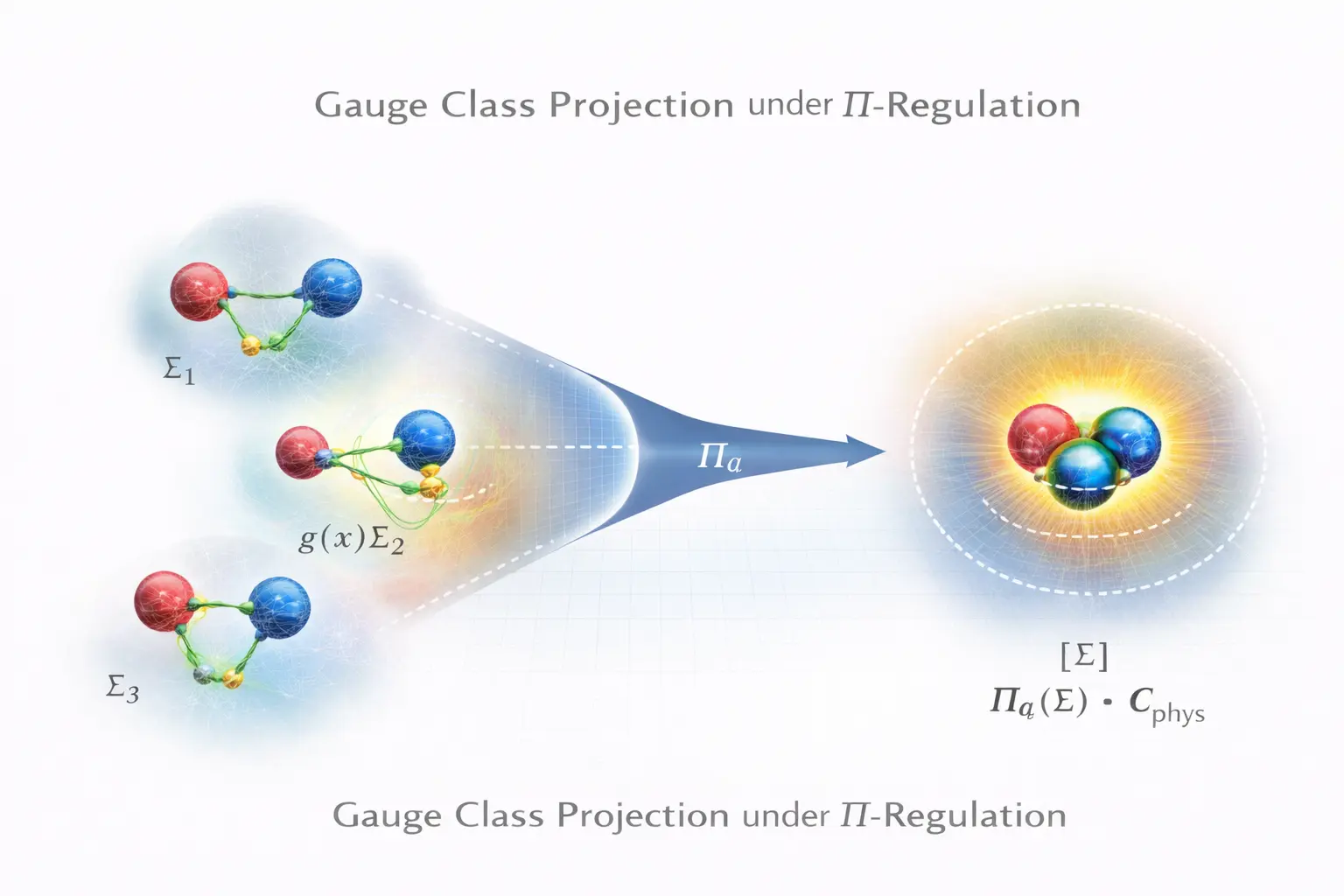
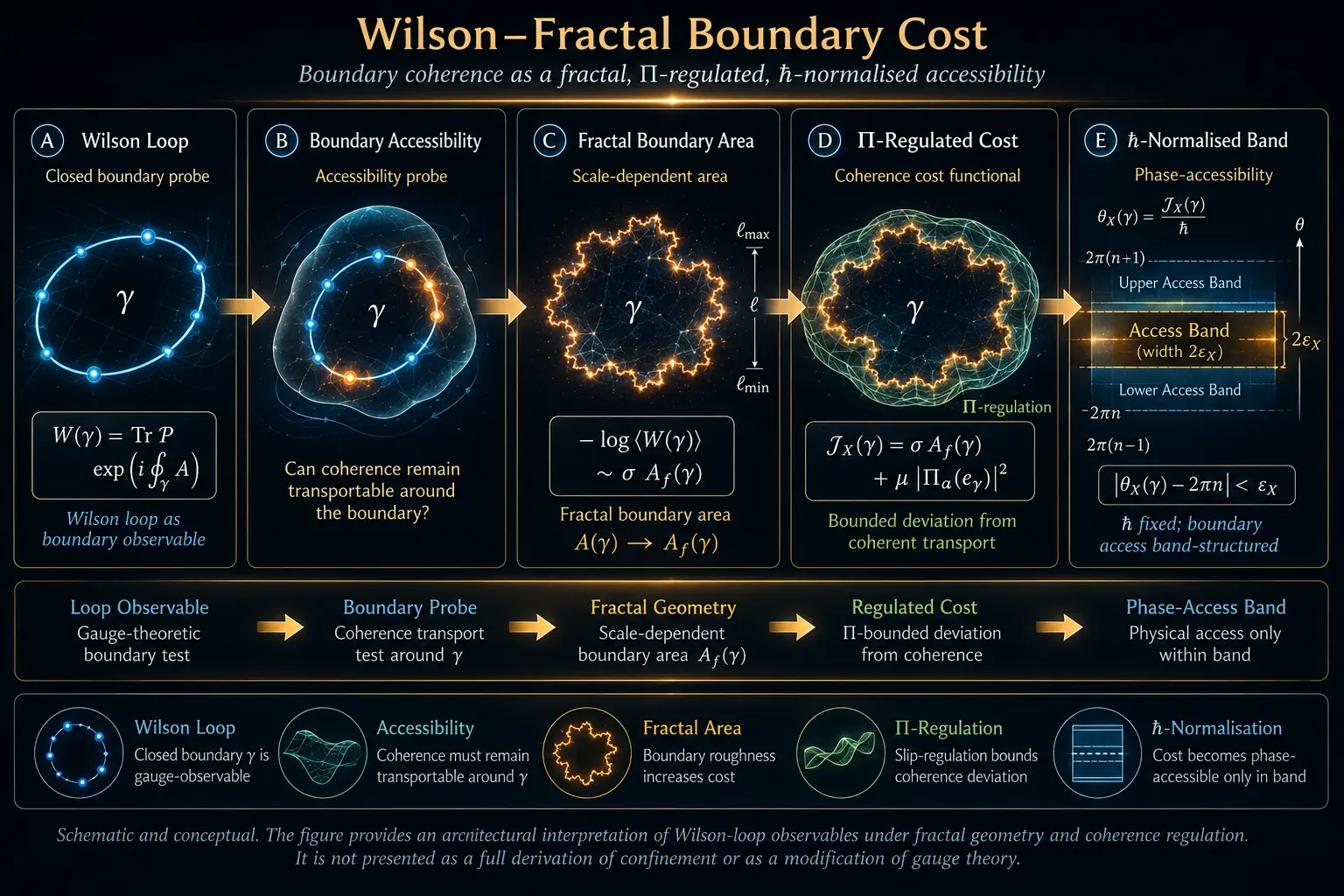
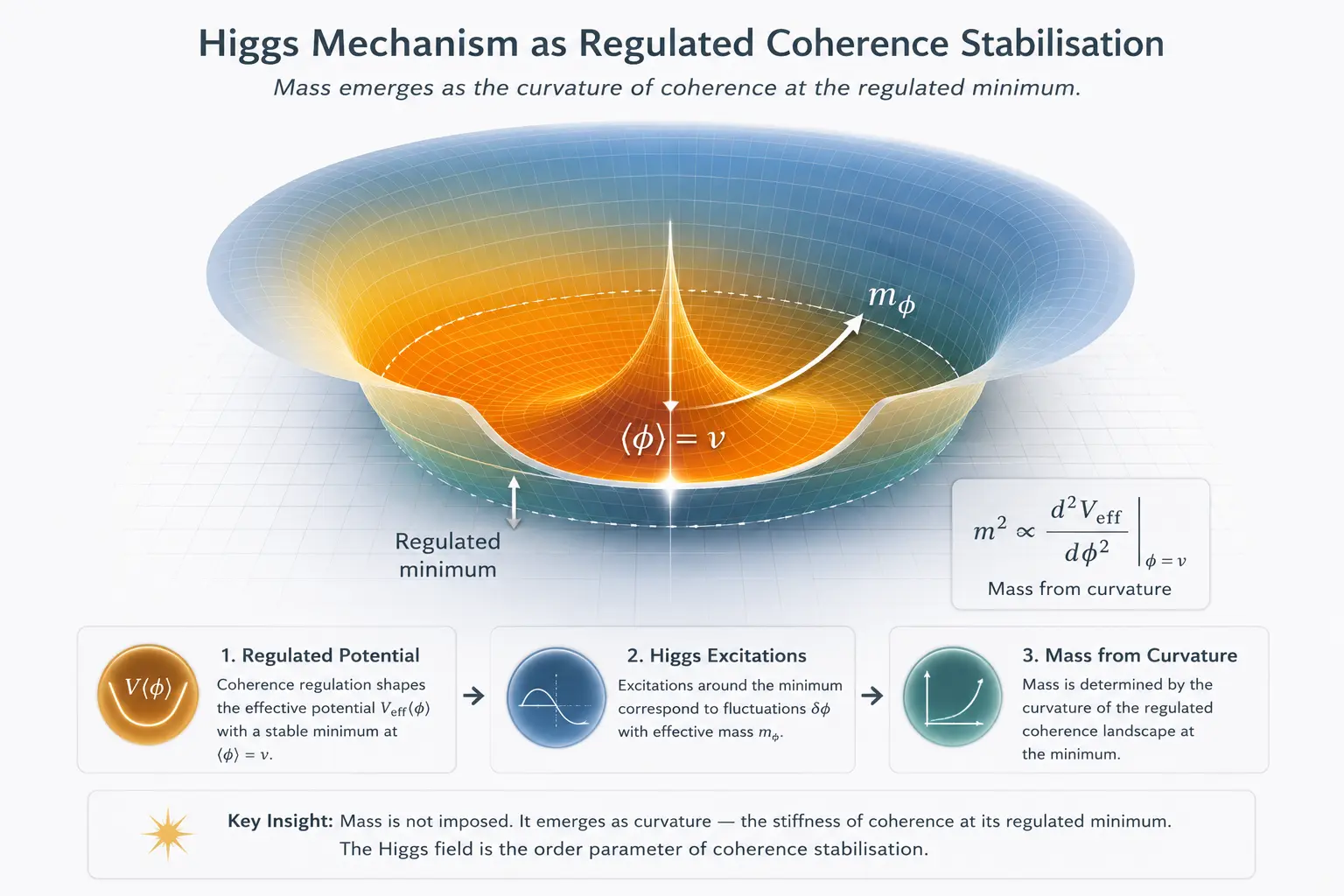
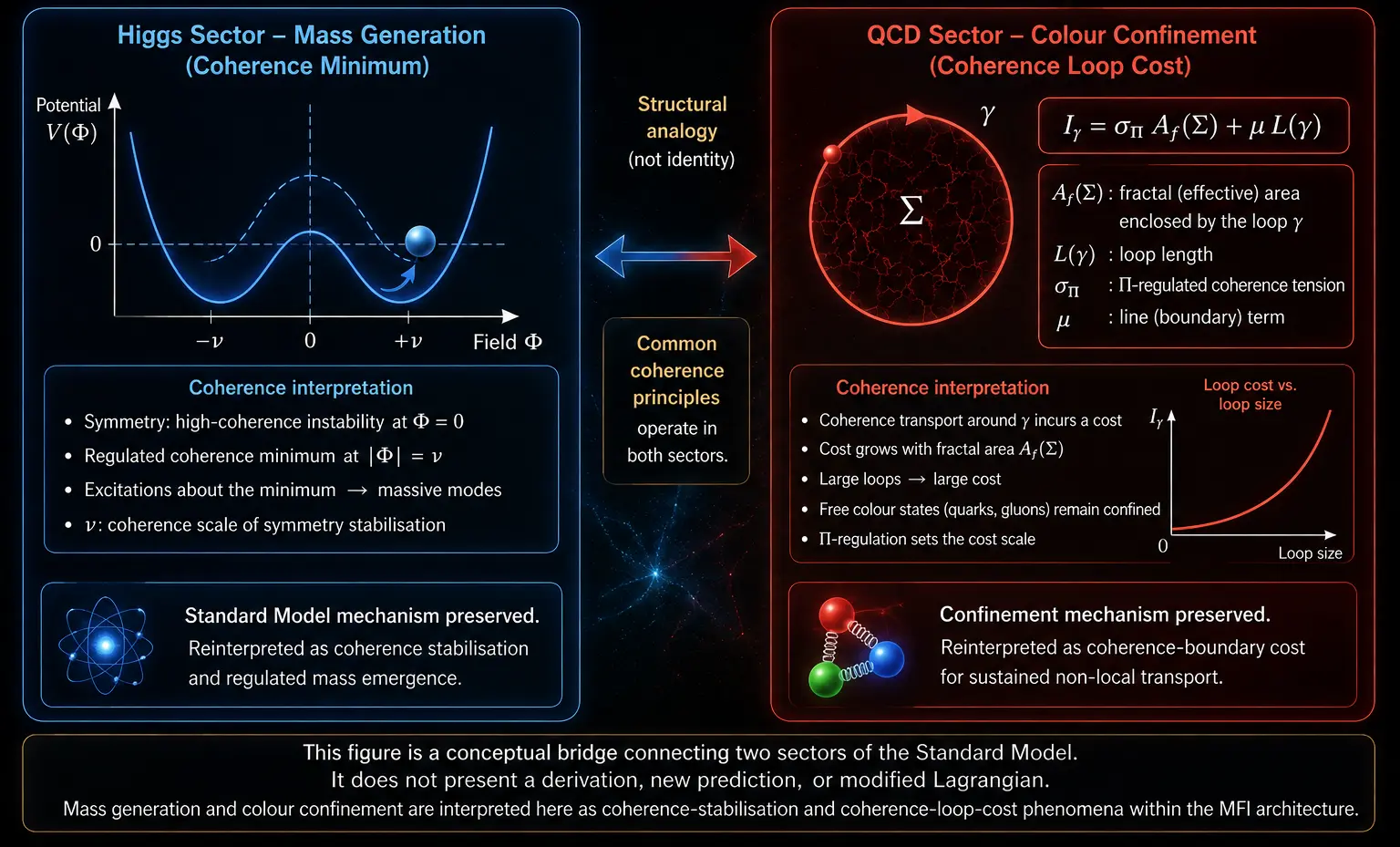
Exploratory constructions from the extended formal programme, separated from the paper’s central architectural claims.
These figures present schematic correspondences and modelling directions. They are not derivations, new empirical predictions, modifications of established field theories or claims of completed physical unification.
MAIN ARCHITECTURAL CLAIMS
The paper’s conclusions are presented at the level of an extensible formal-conceptual architecture.
A stabilised coherence regime whose informational structure remains repeatedly accessible across resolution layers.
Distributed accessibility structures through which coherent material configurations can form and interact.
Integrated regulatory constraint that changes which configurations can remain accessible, stable and repeatable.
A bounded interface that admits adaptation, information intake and inter-scale regulation.
Irreversibility is interpreted through loss of accessible resolution while established empirical laws retain their operational validity.
Conditional invariance within shared coherence and resolution regimes; mathematics expresses the surviving structural invariants.
SCOPE & BOUNDARIES
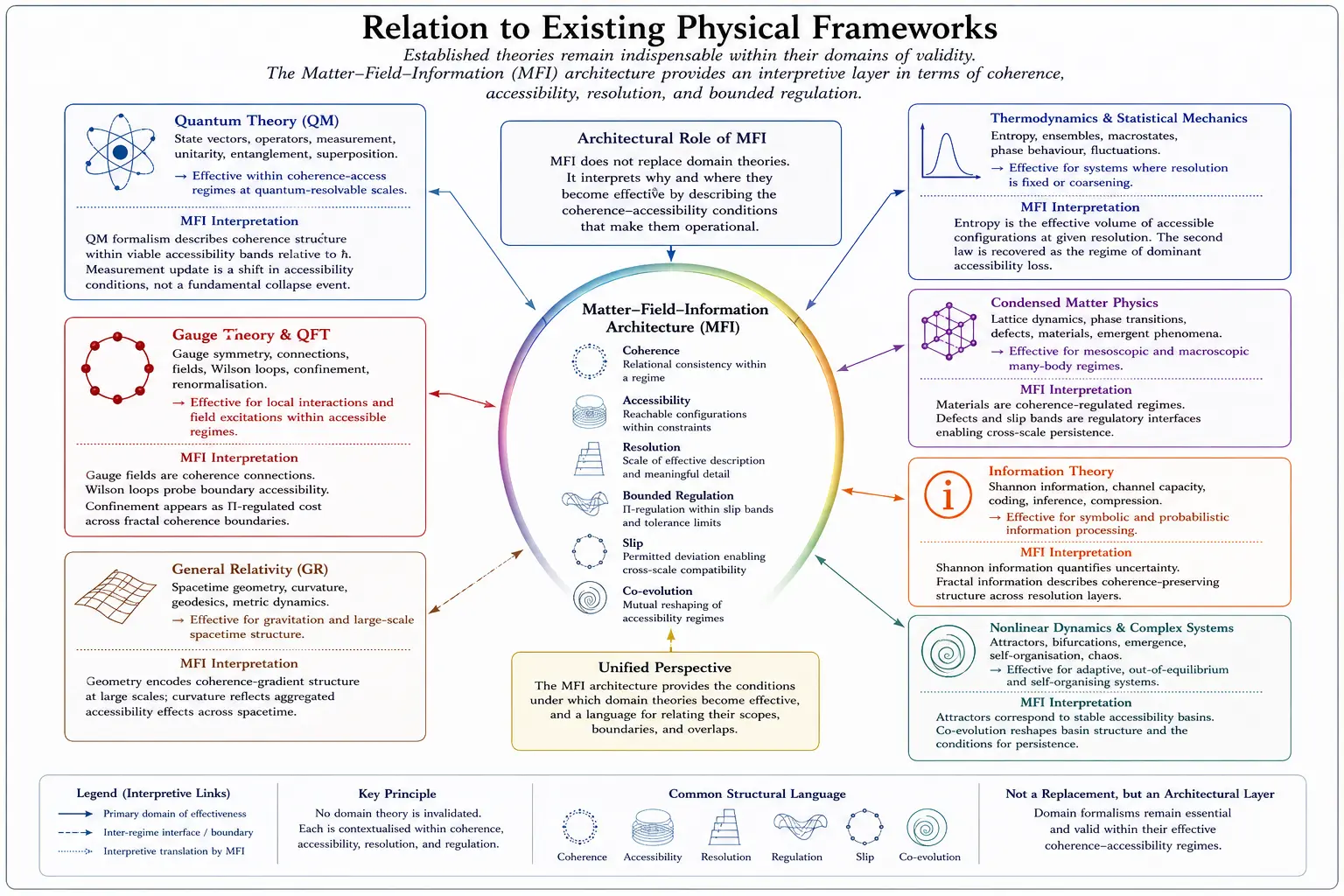
The paper preserves quantum theory, quantum field theory, general relativity, statistical mechanics, thermodynamics, gauge theory and condensed-matter physics within their operational domains.
RELATION TO PHYSICS
MFI proposes a common language of coherence, accessibility, resolution, bounded regulation, slip and co-evolution. The domain theories remain indispensable wherever their formalisms are effective.
PUBLICATION RECORD
Jandó, G. (2026). Matter–Field–Information: Matter as Stabilised Fractal Information under Coherence Regulation [Preprint]. Zenodo.
OUTLOOK / PAPER IV
Paper III closes the material arc with co-evolution and cross-scale stabilisation. Its final bridge treats bounded deviation as potentially generative: once a system can retain, regulate and reuse difference, material persistence can become a substrate for adaptive organization.
Paper IV will ask how chemical and biological systems begin to participate in maintaining the conditions of their own coherence.

CONCEPT FILM · 08
A conceptual bridge from material persistence toward living regulation. The film does not present a complete origin-of-life theory: it shows how bounded difference may become functional when a system can retain, use and feed it back into the maintenance of its own coherence conditions.
Download film ↓